Some years ago, in a conversation with my old friend, the late John Betts, I was bemoaning the fact that there are "artsy" maps of lots of the western rivers that you can buy as a wall-hanger, but very few of eastern rivers of any notoriety, fly fishing-wise. A few months later (we're talking somewhere in the vicinity of 1999) a package from Denver arrived at my door...a gift from John. It contained all kinds of goodies for the base map of the Battenkill he had drawn:
Friday, December 10, 2021
Battenkill Shadow Box
Wednesday, June 9, 2021
The Nepisiguit Grey Atlantic Salmon Fly
Every so often, I get hung up on a fly. This time around, it's the Nepisiguit Grey (note well the Canadian spelling of the G-word!). I don't believe I'd ever even heard of the Nepisiguit River until Paul and Stephanie Elson and Howie Gould took me fishing there one lovely Autumn day a few years ago. More about the river in this post from 2017, if you're interested: https://theriverscourse.blogspot.com/2017/11/miramichi-salmon-camps-fall-2017.html.
There is another spelling, "Nipisiguit", that based on an hour of googling, looks to be an old French way of spelling. I just bought a book, Salmon Fishing on the Nipisiguit - 1874, that lends a little credence to the older spelling. Modern maps all seem to spell it Nepisiguit. Several fly tying books, notably Farrow and Allen's Flies for Atlantic Salmon and Poul Jorgensen's Salmon Flies - Their Character, Style and Dressing use the Nipisiguit spelling, as does Joseph Bates, Jr. in The Art of the Salmon Fly.
Historian David Ledlie, in an article he wrote for The American Fly Fisher (Fall 1976) concerning Dean Sage and his writing of the Ristigouche and its Salmon Fishing found this memo from Sage to his publisher regarding the spelling: "Nepisseguit - Hickman spells it Nepisaguit and it is also spelled Nepiseguit and Nepisiguit, but my spelling is I think the most common and most in accordance with the pronounciation."
Others, including Bates and Richards Fishing Atlantic Salmon - the Flies and the Patterns and the monumental Hardy's Salmon Flies - Patterns from the Fly Tying Department 1883-1969 use the Nepisiguit spelling.
In its earliest form, it's a beautiful fly - this one tied by Tyler Thompson. Click on the pics for a larger version!
Tag: Oval gold tinsel
Tip: Yellow floss
Tail: Golden Pheasant crest
Butt: Peacock herl
Rib: Oval gold tinsel
Body: Gray underbelly fur of a Muskrat
Throat: Grizzly hackle
Wing: Black Bear hair
Head: Black
Monday, January 11, 2021
Save the Date! MSA-US Atlantic Salmon Celebration 2021
Wednesday, November 25, 2020
An etching project with Adriano Manocchia
Artist Adriano Manocchia and I go way back...so far back that I can't remember just how far back far back is! We've fished together a lot, mostly on the Batten Kill, but some warm water stuff, too. Even a trip to Pennsylvania to fish together. We've worked on his vehicles a bunch, too. Everything from classic pick up trucks to his Austin Healy. Good times.
He has had an MGB restoration project to keep him busy during the warm weather and I have never-ending yard work to do then as well. But as the cooler weather was showing up, we starting talking about what we were going to do to keep out of trouble when the weather started keeping us indoors.
I've been tying some older featherwing flies over the last year or so; I enjoy the look of them, and once I got bronze mallard feathers to bend to my will somewhat consistently, I began to enjoy tying them. Out of the blue one day a month or so ago, Adriano wondered out loud to me about doing an etching centered around those old featherwings. He didn't have to suggest that to me twice; I jumped right in and sent him photos of the flies I had done to date.
He came up with a lovely concept that harks back wonderfully to days gone by on the Miramichi. Love the gent poling - not paddling - the canoe. Just the way it's done on that river. He hand-colored the flies, really capturing the look of 'em.
Uh oh - my turn. While Adriano is selling some of the edition of twenty unframed (go here: http://adriano-art.com/), my job was to create a fly plate (when did shadow boxes full of flies ever become known as fly plates?) - one for him, one for Bridget and me, and one as a donation to the Atlantic Salmon Museum up in Doaktown, NB. I said I'd like to frame 3 or 4 to sell mostly to raise money to buy more framing and matting materials for more donations to groups associated with the Atlantic salmon. A guy can only dip into his social security check so often.
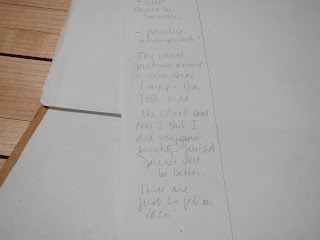
I usually fool around with a design for matting on a big piece of white cardboard or paper and then transfer that design to a first set of mats. In this photo, you can see the white paper under the double mat, which really shows all the changes I end up making to the design.
Once I've got the mat scheme down to what I want it to be, I've actually learned that it saves a lot of time if I do however many sets I'll need all at one time. If you have a small shop like mine that has to serve as both a woodworking and a framing space, there is a major clean-up that has to be done, say, between making frames and making mats. Sawdust is the enemy. So here's a tidy stack, with a couple different mat options, ready for flies and frames:
Friday, October 16, 2020
A Grandfather Remembered and Revered
I did not know my own grandfathers well at all. Truth be told, I never even met my mother's father, but I think, based on the one photo I have of him, that I inherited my moustache from him. My father's father was an avid bird hunter and gear fisherman. I have a photo of two of his setters, and a few of his shotgun shell boxes. You can click on the pics to see an enlarged version.
Sadly, I never got to hunt or fish with him.
Not so for a fellow that recently contacted me about a creating a shadow box through Speypages message system. Johnny Maltby's grandfather Charles (Chuck) Maltby was also a serious hunter and angler, and he and his wife would, according to John, often pick him up and take him fishing after school. Chuck Maltby and his wife relaxing along the Ausable in Michigan:
John relates that his granddad was an architect, but was mostly a troutfisher, woodworker, and grouse hunter. And an artist on several levels. He made John this bobbin threader:
He made these tackle boxes for the Kalamazoo Trout Unlimited chapter every year:
John told me that the binders behind the box above contain his grandfather's notes on every trout over 6 inches that he caught between 1951 and 2011. John wryly noted that "everyone thinks Robert Travers caught the most trout in Michigan...they are very wrong!"
Chuck Maltby took many trips to Yellowstone over the years, and would draw his own post cards to send back to the family. He also tied his own flies. These two facts lead us to why John contacted me in the first place: he wanted a shadow box that contained mementos of his grandfather's talent and thoughtfulness. I agreed that it was a delightful idea, and why didn't John send me some cards and flies and we'd see what would become of it.
John sent me these two post cards that his grandfather drew, and 6 flies he tied:
I was unsure about how to mount the post cards and so purchased some clear "envelopes" that post card collectors use to store their cards. That was never going to look right, so I eventually mounted them the same way I mount lithographs - with an acid-free hinge/tape system.
I played around with arrangements, and settled on this one:
That's the easy part. Now a person has to start worrying about windows and spacers and such, and draw it out.
So, you get the top mat all cut out and put back together, now you have to stick the bottom mat on to that with two sided tape, and map out all the new cuts. Gets a little dizzying!
I selected mats that I thought complemented the art, and I think it worked out. I also used only an eighth inch difference between the mats, instead of a more customary one quarter inch.
Adding a one half inch foam core spacer gave the framing the depth it needed for the flies:
Now, about those flies. I'm used to mounting nice big Atlantic salmon wet flies, either on their own posts or using beads:
These flies were little, puffy trout flies. What to do? I can (and do) make myself superglue a big salmon fly to a post by the hook point. That's still what museum folks (remember, I used to be one of those) want: a reversible attachment. And the bead method is totally reversible. Time for some experiments. I have seen stiff, tiny diameter wire twisted around a fly to mount it (I have a John Betts litho with the fly mounted that way by a fellow in Denver), but this framing has to travel from Vermont to Chicago; I need a pretty bulletproof method to keep the flies aligned.
I needed a different kind of bead to "shroud" the wire. Enter Heddie, from my high school homeroom fifty two years ago. We are "friends" on facebook (even though she became a lawyer after high school) and I knew she is into "beading." She turned me on to what has to be the world's biggest bead company, and we came up with just what the lawyer ordered...a little tiny clear tube that the wire could pass through on its way through the matboard to be secured on the other side.
My first attempt looked like this:
That silver wire wasn't going to cut it, so yippee, more fly tying materials!
A nice delicate yet stout arrangement:
Pretty invisible set-up looking head on:
I chose a red chestnut stain for the oak frame. Think it complemented the artwork nicely.