I apologize. I totally screwed up in my blog post Dyeing Mohair and Tying the Glenlivet Salmon Fly. I misinterpreted/misunderstood Bob Warren's comments to me about the fly prior to writing that post and want to set the record straight. Here are the facts and the real Glenlivet (not my best tie; problems with trembling hands): Bob designed the fly for his wife, Linda, soon after she took up salmon fishing. She was doing well with his Cutty Sark, but he felt she should have her own fly, named, like the Cutty is after his favorite scotch, the Glenlivet, her favorite scotch. The real Glenlivet:
Tag: Oval Copper Tinsel
Butt: Chartreuse Gordon Griffiths floss
Tail: Red Golden Pheasant Breast feather
Body: Mohair dyed emerald green
Rib: Oval Copper tinsel
Throat: Black hen
Wing: Wood duck flank feather (tented)
Head: Red
A bottle of Glenlivet bears a striking resemblance, eh?
So what of the fly in the last post?
Well, we know its not a Glenlivet. I described it to Bob over the phone and all he could figure was that it is some simplified Balmoral that he was experimenting with. The body would certainly lead one to think so. It's such a pretty fly that I tied a batch of them before my hands went south (saw neurologist the other day; it's Essential Tremor. He gave me a drug for it. Hope it works)
Anyway, just wanted to set the record straight. The history of flies is murky enough without me muddying things up further. Now, I better go and re-work that other blog post.
Cheers,
Gary
Sunday, February 28, 2016
Sunday, February 7, 2016
Dyeing Mohair and tying a simplified Balmoral salmon fly
A couple weeks ago I was trying to tidy up my tying bench a bit (an endeavor doomed to an epic fail) and found a pair of flies tied by my good friends and salmon camp pals Bob and Linda Warren. I think I could tell a Bob Warren-tied fly from across a room: neat, tidy, sparse, perfect small head. And a tented wing like no one else I know can create. Bob's simplified Balmoral, on a double (shows how long ago he tied it; hasn't tied doubles in years):
And Linda's fly, tied on a single (this low water version has been fished, if I recall correctly):
I, er, borrowed that photo from this website, where, for the curious-natured among readers, you can find out more about these interesting creatures: http://articles.extension.org/pages/19272/goat-breeds-angora
It also turns out that Bob has a BIG stash of washed angora mohair, and that he'd be happy to send me a batch to dye up and split with him in the right colors for the Glenlivet. Good deal! A few days later, it arrived. Since it had been commercially washed, I would have to spend far less time washing it. Mohair contains a lot of Lanolin, which, if not removed, prevents the hair from taking the dye effectively. Part of the lot he sent me:
You can "tease out" single locks of the stuff:
Here's the process I used to dye the mohair. It is essentially the same process I use for all the feathers and hair I dye. I should mention that I did google "dyeing mohair". Interestingly, most of the sites with instructions of one type or another are "doll hair" sites. That was a neat surprise!
My first step, even though this was pre-washed material, was to wash it again with Synthrapol:
I'm fortunate to have a stainless steel sink in my shop; I do all my dyeing there. I am lucky to have that shop, from both a convenience and a self-preservation perspective. Trust me on this: DO NOT do your dyeing in the kitchen...unless you have: A. a death wish or B. like paying alimony. The sink with mohair being washed:
Over time, I've developed a collection of the dyes I use most commonly, uncharacteristically neatly stored in a drawer of the old medical cabinet I use as my dyeing platform:
Looking through my collection of dyed materials, I found two pieces of "white bear" that match the body sections of the Glenlivet perfectly. The two dyes:
It's important to use acid dyes in a stainless steel vessel, over a controllable heat source, with a thermometer that tells you the temperature of the dye bath. Here's my set-up, all obtained pretty cheaply via ebay (check out the stains on the formica countertop...think those would boost your popularity in the kitchen??):
I like to pre-dissolve the dye in small pan prior to adding it to the bath:
For the three inches or so of water I had in the large vessel, I figured a heaping teaspoon of dye would be plenty:
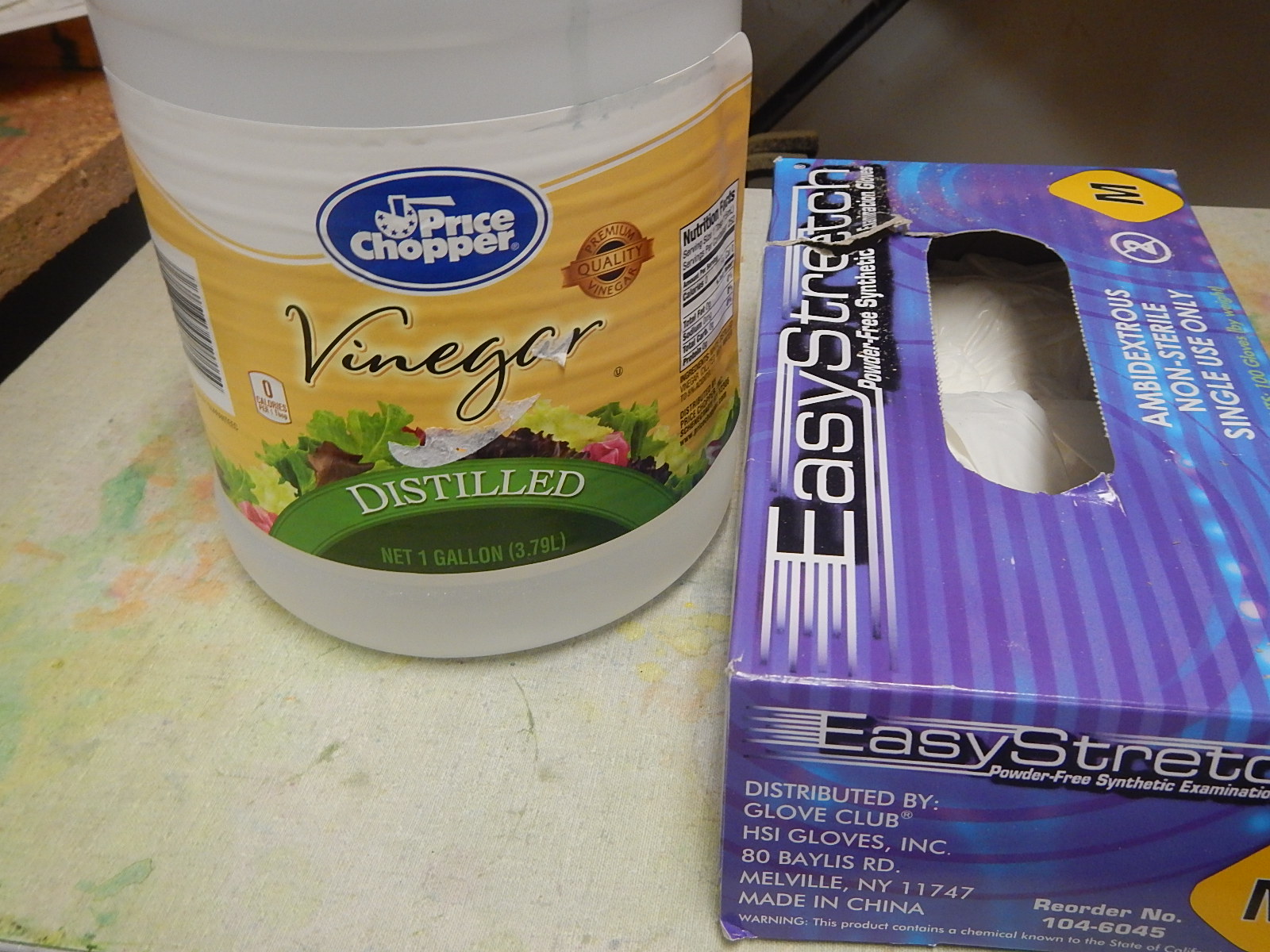
Here are two VERY important things to have on hand when using acid dyes:
You cannot "fix" an acid dye to the material at hand without white vinegar. And you'll be sorry (but very colorful) if you don't wear some brand of rubber gloves.
I typically bring the dye bath up to 175-185 (F) degrees to dye most of the feathers and hair I dye. Reading those doll sites I mentioned before, most of them said to dye mohair around 150 (F) degrees, so that's what I was shooting for (by the way, that is a long-stemmed candy thermometer that goes all the way to the bottom of the dye pot):
Mohair washed and ready for the bath:
And into the bath. This batch spent about 30 minutes in the bath before I felt it to be the right color. During its time in the bath, I poured a generous amount of vinegar into the bath. My experience tells me if I can smell the vinegar coming off the bath, I probably have enough in it. I always move the material to the side of the bath so I can add the vinegar to it without pouring it directly onto the material.
Once I've achieved the color I'm looking for, I remove it from the bath and place it directly into a warm water bath with a bit of Synthrapol in it:
I swish it around quite a bit in the Synthrapol bath, then hold it under the faucet, rinsing and wringing it until the water I'm wringing out runs clear, which means that what I'm holding in my hands is all material with fixed dye in it; nothing to run out later when a fly tied with it hits the water. The finished Kelly Green and Sapphire Blue batches ready to dry:
When I can't blow dry a material (like a piece of fur or an entire chicken cape) I use an old pillow case and our dryer. I just place the batch in the pillow, tie a not in the open end and chuck it in the dryer, medium heat for as long as it takes to dry. Worked very well in this instance, as well as when I've dyed up a batch of individual feathers (and no one is the wiser that I've been using the dryer for illicit purposes!):
After the two batches dried, I teased out a lock of each to tie a simplified Balmoral from:
Time to try tying the fly. It usually takes me 3 or 4 tries at a new fly before I'm happy with it. In the case of this fly, it's not a particularly good looking end product, and I know there are other ways to tie the same fly, but I wanted to bring a good, effective fly (and far prettier than most!) to a broader audience than it has heretofore been exposed.
This fly, like Bob's Cutty Sark, has a peach floss butt, which is a blend of flosses. Bob uses, as do I, the now essentially unavailable Gordon Griffith's floss. The blend is 4 parts orange floss, two parts yellow, and one part green. If you tried to blend pieces of this floss right off the spool, you'd have a rope on your hands. Fortunately, GG floss divides easily into two pieces:
Here are the split strands ready for blending:
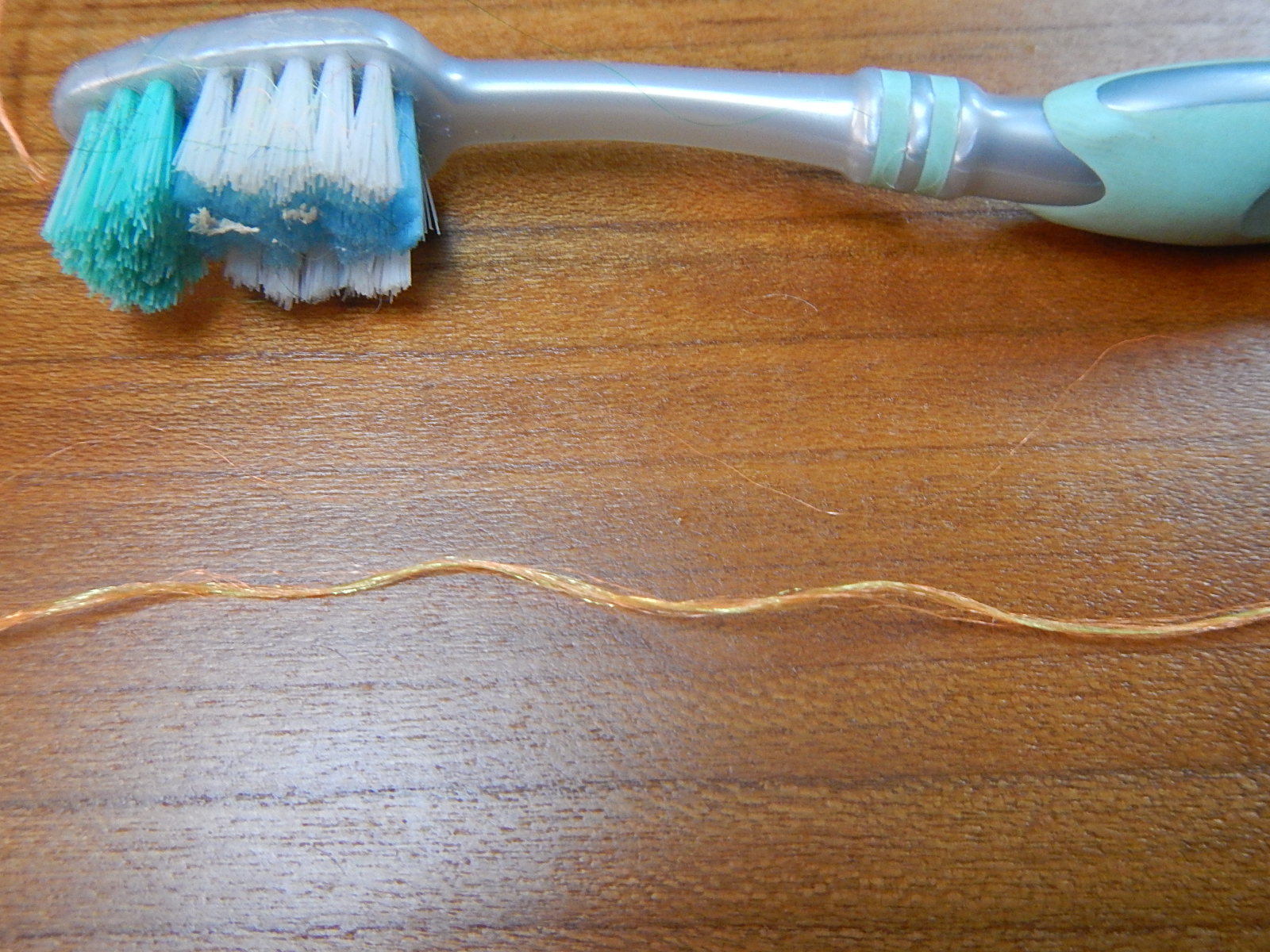
I use a soft toothbrush to stroke the strands together, blending them slowly, starting with two strands and then adding the next strand when the previous strands are blended together:
The finished peach floss:
And then I split that piece into three finer pieces for a less bulky butt (that sounds funny.)
Okay, NOW we can tie the fly:
1. I wrap the hook with white thread to give other materials something to hang on to:
2. Tie in the small, oval copper tinsel for the tag and rib:
3. I use 4 wraps of tinsel to build the first part of the tag:
4. Use the thread to move the tinsel forward to make room for second part of the tag,the peach floss:
5. Tie in the floss:
6. Wrap floss to complete the tag and tie in Golden Pheasant Crest tail (Note: I'm going to wish I had wrapped the materials to this point in a little closer to the head, smoother and more tapered at the head):
7. Time for the butt. Dub a tiny amount of black beaver dubbing onto your thread:
7. Wrap the butt:
8. Oops, forgot to show tying in the green mohair and wrapping it, but here's the blue:
9. Body finished (now you can see why I mentioned that I wish I had taken the "under materials" farther forward, and should have paid a little more attention to lumps under the body. But hey, I was tired from all that dyeing!!):
10. Wrap the ribbing:

11. Tie in a black hen hackle for the collar:
12. Wrap the collar (I made 4 wraps, shoulda used 3):
13. Tie in the wood duck flank feather for the tented wing (I like to put the feather shaft through the hook's eye; helps me keep things centered). Keep the feather folded as best you can as you draw it to its final length (even with the end of the tail):
14. Tie wing off, finish the head, start layering on the Cellire varnish, and you're good to go:
Is this a fly worth tying? Ask Linda Warren!
Cheers,
Gary
And Linda's fly, tied on a single (this low water version has been fished, if I recall correctly):
Looking at the fly under the microscope, so to speak, I couldn't identify the body material. Not floss, not yarn. Hmmmm. Call Bob. Turns out its Mohair, from the Angora goat:I, er, borrowed that photo from this website, where, for the curious-natured among readers, you can find out more about these interesting creatures: http://articles.extension.org/pages/19272/goat-breeds-angora
It also turns out that Bob has a BIG stash of washed angora mohair, and that he'd be happy to send me a batch to dye up and split with him in the right colors for the Glenlivet. Good deal! A few days later, it arrived. Since it had been commercially washed, I would have to spend far less time washing it. Mohair contains a lot of Lanolin, which, if not removed, prevents the hair from taking the dye effectively. Part of the lot he sent me:
You can "tease out" single locks of the stuff:
Here's the process I used to dye the mohair. It is essentially the same process I use for all the feathers and hair I dye. I should mention that I did google "dyeing mohair". Interestingly, most of the sites with instructions of one type or another are "doll hair" sites. That was a neat surprise!
My first step, even though this was pre-washed material, was to wash it again with Synthrapol:
I'm fortunate to have a stainless steel sink in my shop; I do all my dyeing there. I am lucky to have that shop, from both a convenience and a self-preservation perspective. Trust me on this: DO NOT do your dyeing in the kitchen...unless you have: A. a death wish or B. like paying alimony. The sink with mohair being washed:
Over time, I've developed a collection of the dyes I use most commonly, uncharacteristically neatly stored in a drawer of the old medical cabinet I use as my dyeing platform:
Looking through my collection of dyed materials, I found two pieces of "white bear" that match the body sections of the Glenlivet perfectly. The two dyes:
It's important to use acid dyes in a stainless steel vessel, over a controllable heat source, with a thermometer that tells you the temperature of the dye bath. Here's my set-up, all obtained pretty cheaply via ebay (check out the stains on the formica countertop...think those would boost your popularity in the kitchen??):
I like to pre-dissolve the dye in small pan prior to adding it to the bath:
For the three inches or so of water I had in the large vessel, I figured a heaping teaspoon of dye would be plenty:
Here are two VERY important things to have on hand when using acid dyes:
You cannot "fix" an acid dye to the material at hand without white vinegar. And you'll be sorry (but very colorful) if you don't wear some brand of rubber gloves.
I typically bring the dye bath up to 175-185 (F) degrees to dye most of the feathers and hair I dye. Reading those doll sites I mentioned before, most of them said to dye mohair around 150 (F) degrees, so that's what I was shooting for (by the way, that is a long-stemmed candy thermometer that goes all the way to the bottom of the dye pot):
Mohair washed and ready for the bath:
And into the bath. This batch spent about 30 minutes in the bath before I felt it to be the right color. During its time in the bath, I poured a generous amount of vinegar into the bath. My experience tells me if I can smell the vinegar coming off the bath, I probably have enough in it. I always move the material to the side of the bath so I can add the vinegar to it without pouring it directly onto the material.
Once I've achieved the color I'm looking for, I remove it from the bath and place it directly into a warm water bath with a bit of Synthrapol in it:
I swish it around quite a bit in the Synthrapol bath, then hold it under the faucet, rinsing and wringing it until the water I'm wringing out runs clear, which means that what I'm holding in my hands is all material with fixed dye in it; nothing to run out later when a fly tied with it hits the water. The finished Kelly Green and Sapphire Blue batches ready to dry:
When I can't blow dry a material (like a piece of fur or an entire chicken cape) I use an old pillow case and our dryer. I just place the batch in the pillow, tie a not in the open end and chuck it in the dryer, medium heat for as long as it takes to dry. Worked very well in this instance, as well as when I've dyed up a batch of individual feathers (and no one is the wiser that I've been using the dryer for illicit purposes!):
After the two batches dried, I teased out a lock of each to tie a simplified Balmoral from:
Time to try tying the fly. It usually takes me 3 or 4 tries at a new fly before I'm happy with it. In the case of this fly, it's not a particularly good looking end product, and I know there are other ways to tie the same fly, but I wanted to bring a good, effective fly (and far prettier than most!) to a broader audience than it has heretofore been exposed.
This fly, like Bob's Cutty Sark, has a peach floss butt, which is a blend of flosses. Bob uses, as do I, the now essentially unavailable Gordon Griffith's floss. The blend is 4 parts orange floss, two parts yellow, and one part green. If you tried to blend pieces of this floss right off the spool, you'd have a rope on your hands. Fortunately, GG floss divides easily into two pieces:
Here are the split strands ready for blending:
I use a soft toothbrush to stroke the strands together, blending them slowly, starting with two strands and then adding the next strand when the previous strands are blended together:
The finished peach floss:
And then I split that piece into three finer pieces for a less bulky butt (that sounds funny.)
Okay, NOW we can tie the fly:
1. I wrap the hook with white thread to give other materials something to hang on to:
2. Tie in the small, oval copper tinsel for the tag and rib:
3. I use 4 wraps of tinsel to build the first part of the tag:
4. Use the thread to move the tinsel forward to make room for second part of the tag,the peach floss:
5. Tie in the floss:
6. Wrap floss to complete the tag and tie in Golden Pheasant Crest tail (Note: I'm going to wish I had wrapped the materials to this point in a little closer to the head, smoother and more tapered at the head):
7. Time for the butt. Dub a tiny amount of black beaver dubbing onto your thread:
7. Wrap the butt:
8. Oops, forgot to show tying in the green mohair and wrapping it, but here's the blue:
9. Body finished (now you can see why I mentioned that I wish I had taken the "under materials" farther forward, and should have paid a little more attention to lumps under the body. But hey, I was tired from all that dyeing!!):
10. Wrap the ribbing:
11. Tie in a black hen hackle for the collar:
12. Wrap the collar (I made 4 wraps, shoulda used 3):
13. Tie in the wood duck flank feather for the tented wing (I like to put the feather shaft through the hook's eye; helps me keep things centered). Keep the feather folded as best you can as you draw it to its final length (even with the end of the tail):
14. Tie wing off, finish the head, start layering on the Cellire varnish, and you're good to go:
Is this a fly worth tying? Ask Linda Warren!
Cheers,
Gary
Sunday, January 24, 2016
The Silver Down(-)East(er) ??
My good friend Bill Dreyer always seems to be swinging a different fly than is, well, more usually tied on in our salmon camp. Last July, he hooked this beautiful salmon right in front of me:
When I shouted across the river, "What fly?", Bill responded, "Silver Down Easter." I said to myself, "Wow, bright day, bright fly!" And promptly forgot about it, which I am very good at doing. Ask anybody.
Jump forward to December. A very nice gentleman from Toronto emailed me and offered me a fly tyer's dream (well, to me, anyway): Here's XXX number of dollars, tie me up what you think are the best flies for the Miramichi...no restrictions, except that he did want a batch of Cutty Sarks, Celtic Beauties, Glitter Bears, some Bombers, and (lol, sadly) some White-tailed Green Machines.
I have a pretty good list of what I feel are the best Miramichi salmon flies. I get to hang out with some of the best guides and salmon anglers/tyers on the river, and a lot of their wisdom has slowly sunk into my aging gray matter. The fly order is a big order, and I want to touch all the bases for my customer. Got to thinking about that nice fish Bill hooked, and felt I better include some Silver Down Easters in the order.
I also have a pretty complete library when it comes to modern atlantic salmon flies, but I always like to google around (isn't it funny how that noun has become a verb?) to see what's out there. During the course of 2015, I tied some 60 hairwing salmon flies for Mike Valla's upcoming book, Tying and Fishing Hairwing Flies - Atlantic Salmon Flies to Steelhead Flies. Among those flies is a Silver Down East, originated by Mainer Phil Foster. This is the fly that will be in Mike's book:
Fellow Blogger Alan (he has a blog that is a feast for the eyes and mind: http://smallstreamreflections.blogspot.com/2016/01/another-red-barntumbledown.html ) sent me this photo, presented with his permission, of Silver Down East's tied by its originator, Phil Foster:
But wait. Bill said he hooked that nice fish on a Silver Down Easter. Silver Down East? Silver Down Easter? Same fly? Different flies? Before delving into my library, Google found me this:
http://flyanglersonline.com/flytying/atlantic/hairwing/hwsilverdowneast.php, wherein I found that the Silver Down East's originator, Phil Foster, was quite displeased that Colonel Joe Bates, Jr, in his book, Atlantic Salmon Flies and Fishing, gave credit for the fly to someone in New Brunswick. Hmmmm, better check the book.
Uh-oh. From Bates' book (page 209): "Since before 1960, Bert (Miner) has been tying a fly which is exactly the same as the Silver Down-Easter except that it has a wing of natural brown Squirrel Tail (instead of black). Bert named this version the Cains River, and it is very popular in that area." From the flyanglersonline page, here's Foster's recipe for the Silver Down East:
Thread: Black
Tag: Flat Gold Tinsel
Tail: GP (crest)
Butt: Black Ostrich
Body: Flat Silver Tinsel
Rib: Oval Silver Tinsel
Collar: Orange Hackle Pulled Back
Wing: Russian Red Squirrel Tail
Head: Black
Bates (I'm using the 1970 first edition, published by Stackpole as my reference copy) lists a recipe for the Silver Down-Easter (his hyphenation) and attributes it to Bert Miner (no mention of the Silver Down East or of Phil Foster in the book that I can find):
Head Color: Black
Tag: A very few turns of fine oval silver tinsel
Tail: Golden pheasant crest feather
Butt: Two or three turns of Black Ostrich, very sparse
Body: Medium flat silver tinsel
Ribbing: Fine oval silver tinsel
Throat: A bright orange hackle, sparse and short, tied on as a collar before the wing is applied
Wing: A small bunch of black Squirrel tail hairs or Black Bear hair, rather sparse and extending
to the bend of the hook.
Here's my attempt at a Silver Down-Easter:
Okie dokie, I get that they are two different flies, but I also can understand Foster's unhappiness that Bates attributed the reddish-winged fly to Miner. But maybe Miner really did come up, independent of Foster, with a reddish-winged version. That happens. But I think Foster is off-base when he goes on to say: Colonel Bates' daughter called me in early 1993 and informed me that she was in the process of updating her father's book and would I be interested in helping. I informed her of the problems encountered when her father did the original and would only be interested if the inaccuracies regarding the two flies mentioned were corrected. They weren't!
I consider Pam Bates' (listed as co-author with her at-the-time-of-publication late father Joe Bates) book, Fishing Atlantic Salmon - The Flies and the Patterns, nothing short of inspirational. Edited by my close friend Bob Warren, the book is a feast for the eyes and mind. And here's why I disagree with Foster about his treatment in the book: on page 355, the pattern for the Silver Down-Easter is presented and credited to Miner. From the book:
"The Silver Down-Easter is an important and popular pattern on Maine and Canadian salmon rivers. It is attributed to Bert Miner of Doaktown, New Brunswick, and is one of sevferal variations described earlier under the Blackville. In addition to these are the Down East Special and the Silver Down East, which were originated in Maine."
Fast forward to page 374, where we find a color plate of both the Silver Down East and the Down East Special, with the notation "originated and dressed by Phil Foster." And in the text:
"He (Foster) states that the success of the fly carried it to other rivers in the province of New Brunswick, where it was modified to have a black wing and no tail or butt. It is very similar to the Silver Down-Easter, a Canadian pattern credited to Bert Miner."
In my humble opinion, both Miner and Foster were treated fairly and squarely in Fishing Atlantic Salmon. I don't get why Foster thinks he was mistreated. Once upon a time I was having a little trouble with Ernie Schwiebert regarding his introduction in an article in the journal of a fly fishing museum I ran. He said that in the past the author of the intro had made some inaccurate comments about him. I simply could not see what he was going on about...what did that have to do with the current price of eggs? I asked the author of that introduction (a well-published author and a good friend) what was up. He ransacked his office trying to find where he had ever made an inaccurate statement about Ernie. Couldn't find anything. Ended up simply saying he thought Ernie must be a "self reader", i.e., he read what he wanted to read, not what was on the page.
Maybe that's the case with Phil. In any event, they're both good flies. Especially if you're a fan of the "bright day, bright fly" school of thought.
Cheers!
Gary
When I shouted across the river, "What fly?", Bill responded, "Silver Down Easter." I said to myself, "Wow, bright day, bright fly!" And promptly forgot about it, which I am very good at doing. Ask anybody.
Jump forward to December. A very nice gentleman from Toronto emailed me and offered me a fly tyer's dream (well, to me, anyway): Here's XXX number of dollars, tie me up what you think are the best flies for the Miramichi...no restrictions, except that he did want a batch of Cutty Sarks, Celtic Beauties, Glitter Bears, some Bombers, and (lol, sadly) some White-tailed Green Machines.
I have a pretty good list of what I feel are the best Miramichi salmon flies. I get to hang out with some of the best guides and salmon anglers/tyers on the river, and a lot of their wisdom has slowly sunk into my aging gray matter. The fly order is a big order, and I want to touch all the bases for my customer. Got to thinking about that nice fish Bill hooked, and felt I better include some Silver Down Easters in the order.
I also have a pretty complete library when it comes to modern atlantic salmon flies, but I always like to google around (isn't it funny how that noun has become a verb?) to see what's out there. During the course of 2015, I tied some 60 hairwing salmon flies for Mike Valla's upcoming book, Tying and Fishing Hairwing Flies - Atlantic Salmon Flies to Steelhead Flies. Among those flies is a Silver Down East, originated by Mainer Phil Foster. This is the fly that will be in Mike's book:
But wait. Bill said he hooked that nice fish on a Silver Down Easter. Silver Down East? Silver Down Easter? Same fly? Different flies? Before delving into my library, Google found me this:
http://flyanglersonline.com/flytying/atlantic/hairwing/hwsilverdowneast.php, wherein I found that the Silver Down East's originator, Phil Foster, was quite displeased that Colonel Joe Bates, Jr, in his book, Atlantic Salmon Flies and Fishing, gave credit for the fly to someone in New Brunswick. Hmmmm, better check the book.
Uh-oh. From Bates' book (page 209): "Since before 1960, Bert (Miner) has been tying a fly which is exactly the same as the Silver Down-Easter except that it has a wing of natural brown Squirrel Tail (instead of black). Bert named this version the Cains River, and it is very popular in that area." From the flyanglersonline page, here's Foster's recipe for the Silver Down East:
Thread: Black
Tag: Flat Gold Tinsel
Tail: GP (crest)
Butt: Black Ostrich
Body: Flat Silver Tinsel
Rib: Oval Silver Tinsel
Collar: Orange Hackle Pulled Back
Wing: Russian Red Squirrel Tail
Head: Black
Bates (I'm using the 1970 first edition, published by Stackpole as my reference copy) lists a recipe for the Silver Down-Easter (his hyphenation) and attributes it to Bert Miner (no mention of the Silver Down East or of Phil Foster in the book that I can find):
Head Color: Black
Tag: A very few turns of fine oval silver tinsel
Tail: Golden pheasant crest feather
Butt: Two or three turns of Black Ostrich, very sparse
Body: Medium flat silver tinsel
Ribbing: Fine oval silver tinsel
Throat: A bright orange hackle, sparse and short, tied on as a collar before the wing is applied
Wing: A small bunch of black Squirrel tail hairs or Black Bear hair, rather sparse and extending
to the bend of the hook.
Here's my attempt at a Silver Down-Easter:
Okie dokie, I get that they are two different flies, but I also can understand Foster's unhappiness that Bates attributed the reddish-winged fly to Miner. But maybe Miner really did come up, independent of Foster, with a reddish-winged version. That happens. But I think Foster is off-base when he goes on to say: Colonel Bates' daughter called me in early 1993 and informed me that she was in the process of updating her father's book and would I be interested in helping. I informed her of the problems encountered when her father did the original and would only be interested if the inaccuracies regarding the two flies mentioned were corrected. They weren't!
I consider Pam Bates' (listed as co-author with her at-the-time-of-publication late father Joe Bates) book, Fishing Atlantic Salmon - The Flies and the Patterns, nothing short of inspirational. Edited by my close friend Bob Warren, the book is a feast for the eyes and mind. And here's why I disagree with Foster about his treatment in the book: on page 355, the pattern for the Silver Down-Easter is presented and credited to Miner. From the book:
"The Silver Down-Easter is an important and popular pattern on Maine and Canadian salmon rivers. It is attributed to Bert Miner of Doaktown, New Brunswick, and is one of sevferal variations described earlier under the Blackville. In addition to these are the Down East Special and the Silver Down East, which were originated in Maine."
Fast forward to page 374, where we find a color plate of both the Silver Down East and the Down East Special, with the notation "originated and dressed by Phil Foster." And in the text:
"He (Foster) states that the success of the fly carried it to other rivers in the province of New Brunswick, where it was modified to have a black wing and no tail or butt. It is very similar to the Silver Down-Easter, a Canadian pattern credited to Bert Miner."
In my humble opinion, both Miner and Foster were treated fairly and squarely in Fishing Atlantic Salmon. I don't get why Foster thinks he was mistreated. Once upon a time I was having a little trouble with Ernie Schwiebert regarding his introduction in an article in the journal of a fly fishing museum I ran. He said that in the past the author of the intro had made some inaccurate comments about him. I simply could not see what he was going on about...what did that have to do with the current price of eggs? I asked the author of that introduction (a well-published author and a good friend) what was up. He ransacked his office trying to find where he had ever made an inaccurate statement about Ernie. Couldn't find anything. Ended up simply saying he thought Ernie must be a "self reader", i.e., he read what he wanted to read, not what was on the page.
Maybe that's the case with Phil. In any event, they're both good flies. Especially if you're a fan of the "bright day, bright fly" school of thought.
Cheers!
Gary
Subscribe to:
Posts (Atom)