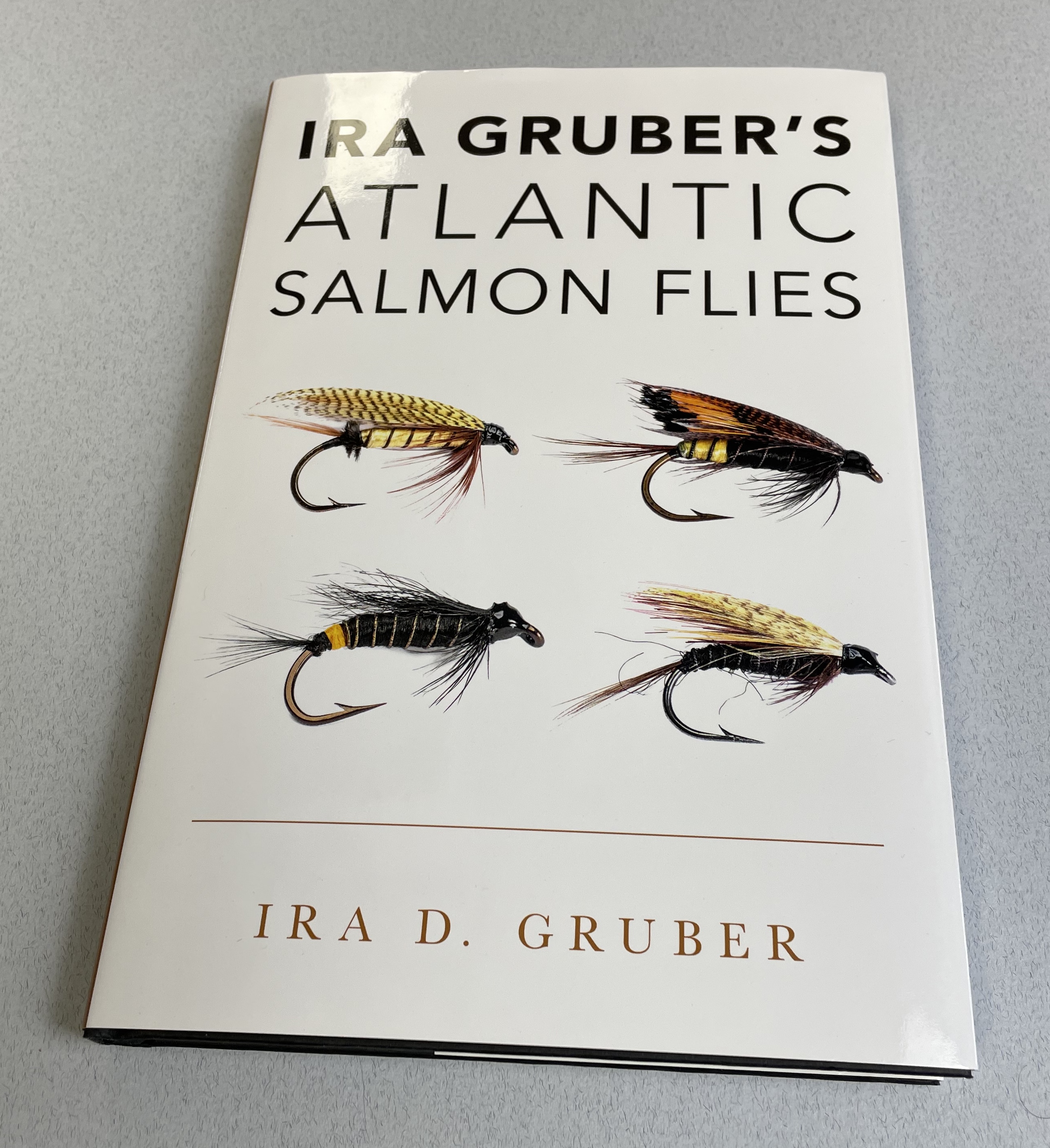
A great many Atlantic salmon anglers, and even a great many Atlantic salmon fly tyers, have likely never heard of Ira W. Gruber. I'm hoping this blog post changes that fact, and a new book by Gruber's grandson, Ira D. Gruber will go a long way towards bringing his grandfather's flies and contributions to Atlantic salmon fly tying to light: Ira Gruber's Atlantic Salmon Flies (Stackpole Books 2022).
Some salmon fly tying friends and I have been anxiously awaiting this book for almost a year. My friend Pam Bates Richards, co-author with her father Col. Joseph Bates of Fishing Atlantic Salmon - the Flies and the Patterns (Stackpole Books 1996), alerted me to its upcoming publication when I asked if there were any Gruber flies in her collection that might help my pals and I tie better copies of this flies. Several emails with grandson Ira D. also shed light on Ira W's flies.
I won't recount Gruber's life and times here...his grandson does a great job of that in his book. In fact, that section of the book was a pleasant surprise to me. I thought it would just center on Ira W's flies. Many authors, including both Pam Bates Richards and Joe Bates - feel that "Gruber's flies form the basis of modern North American flies." If you have any interest in historic Miramichi Atlantic salmon flies and tyers, this is a must-have book.
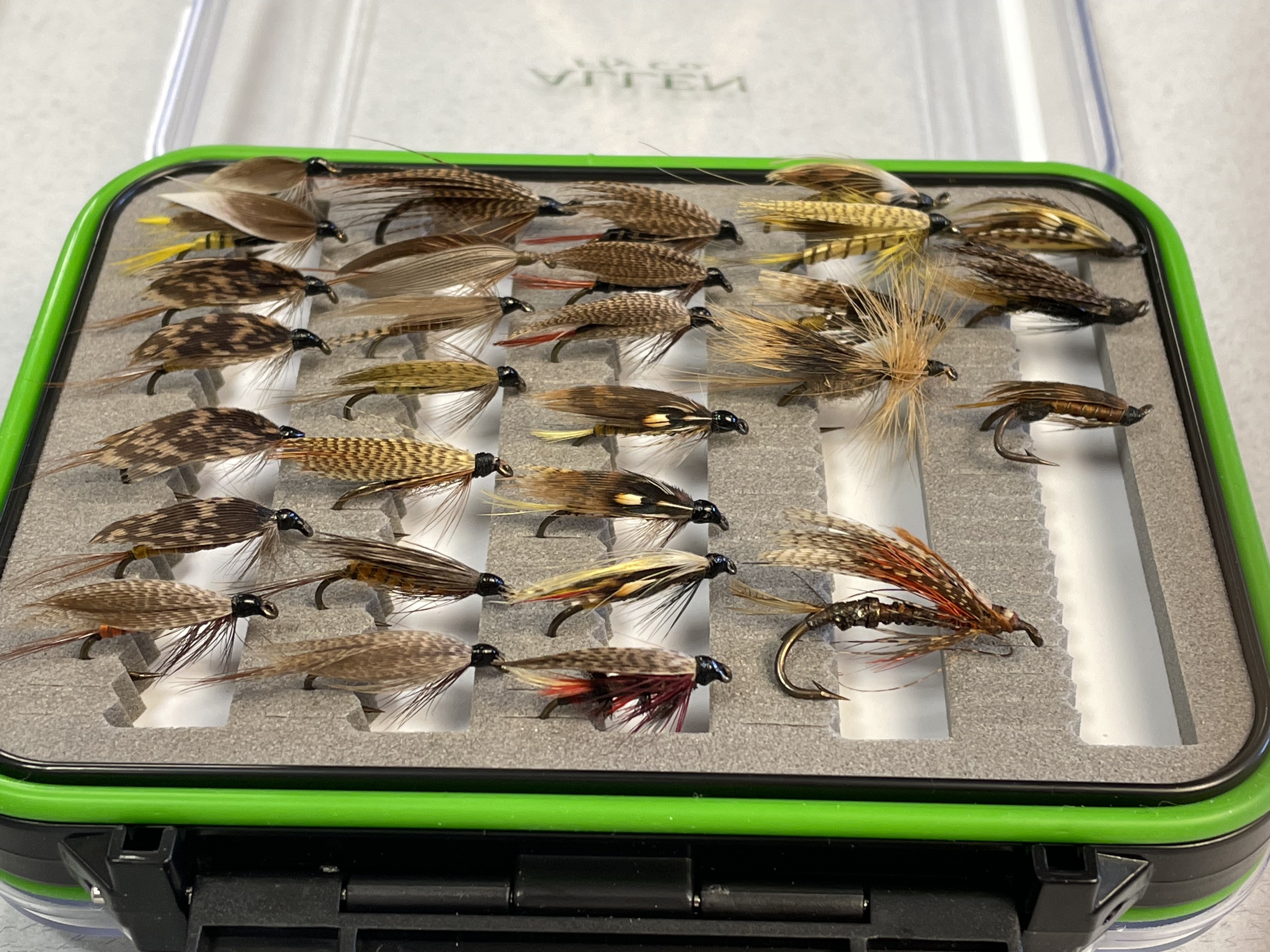
Back in July of 2021, a gentleman posted on the Classic Fly Rod Forum ( http://classicflyrodforum.com/forum/index.php) that he had purchased, at an estate sale, quite a few Ira Gruber flies and several of his personalized boxes. He posted this photo of his treasure find on that forum (And remember that you can click on an image to enlarge it!):
I contacted him, noting my interest in the flies, and the fact that the Atlantic Salmon Museum in Doaktown, NB (I'm on their board of directors) could certainly use a collection like that (meaning the Gruber flies specifically). Without hesitation, he said he'd send them to me to give to the Museum on his behalf. I agreed to do so, and also agreed to frame them so that they would be more publicly accessible than perhaps otherwise presented.
Once I received the flies, I realized I didn't know many of their names, so, with kind permission of the donor, I decided to wait until I had the new Gruber book in hand to try and put names to flies. It worked! Here is a sample of what I was able to put together (love doing this kind of thing!) and I'll let the photos tell the story. First, some of what I received as it came in the mail:
Wouldn't you love to know who wrote on the box? And doesn't that look like a fly DeFeo or Jennings would draw? Did I mention that in the book, Ira D. writes that his grandfather was visited by both of those gentlemen at his camp in Doaktown, NB? The plot thickens.
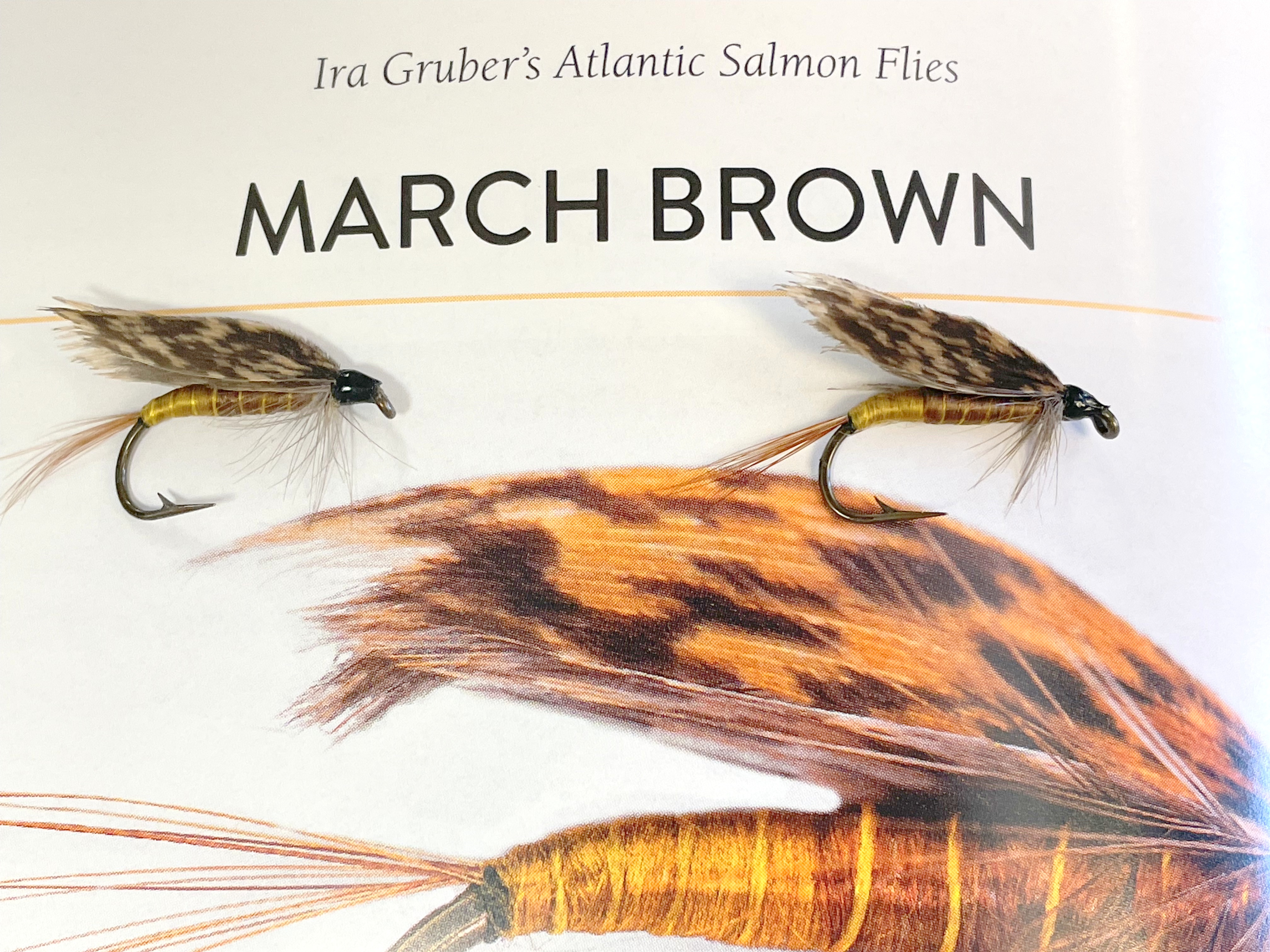
And here is what I have thus far been able to piece together, name-wise (note that the flies I have I photographed with a page from the book as a backdrop. Each fly has an interesting history/description to go along with the photo:
The flies I've identified from the collection sent to me by the generous gentleman from the Classic Fly Rod Forum:
And when it was in its little baggie:
And the American Jock Scott as tied by the late Wallace Doak from a photo (page 425) in Bates and Richards 1996) with the same two Gruber flies:
And perhaps a slight variation (note the tail) in a fly in the collection for the Museum:
That's it thus far for what I can identify in the collection. Can we say for sure that Ira W. Gruber tied them? I mean, the donor of the collection states that he bought the group of flies at an estate sale advertised as Gruber's estate in Ira's hometown, it includes his personalized fly boxes, and, let's face it...Ira didn't seem to give a hoot about how his fly's heads looked, and all of these flies surely do fit within that frame work. My old friend, the late Bob Warren, was always laughing when he joked that Clovis Arseneault's flies looked like he put the head cement on with a popsicle stick. With all due reverence, maybe Ira used a toothpick?? Looking forward to creating a shadow box with these flies in it for the Museum's wall.
Some time ago, I asked a group of great fly tyers if they wouldn't tie up some "old timey" featherwings that we could somehow use as a fundraiser. At that point, we were specifically thinking about a beautiful wall calendar. Well, so far that hasn't worked out, although I did photograph the flies and have them ready for a calendar should someone or some group ever come out of the woodwork to use them for that purpose, but in the meantime, I shadow box framed three sets of the flies (ten flies in each framing) for fundraisers for the Miramichi Salmon Association and the Atlantic Salmon Museum. The first of the framings (I am happy to report!) sold in an MSA online auction in February, 2022 for 700 bucks! It now resides in Atlanta, Georgia (lol, the long arm of the Atlantic salmon!). Here are the three framings, each with a different set of flies as I said, tied by among the best salmon fly tyers in the Maritimes and New England. Here's the first, which sold for $700 (not, I hope obviously, color corrected photo):

And its flies. Note that this set contains two Ira Gruber creations: A Blackville, tied by Jerome Molloy, and an Oriole tied by Lloyd Lutes. Don't forget that you can click on the pic to enlarge it!
And the second, which will be in the next (late April 2022) MSA online auction:
No Gruber creations in this batch:
And the third and final set, which will go on the auction block at the Atlantic Salmon Museum's Hall of Fame dinner on May 14, 2022.
And there's and Gruber creation, the Reliable, on this side, tied by Stephen Nye.
Here are how those Gruber originals (Oriole, Reliable and Blackville), tied by my friends, might look on a nice wall calendar (hint, hint, anybody interested in backing that project??)
If you have any interest at all in the development of Atlantic salmon flies, particularly flies tied specifically for the Miramichi,
Ira Gruber's Atlantic Salmon Flies is a book you need on your shelf or at your tying bench. Might as well make it easy for you, you can buy it here:
This has been a really fun blog post to do. I shoulda worked in a fly fishing museum! Oh, wait, that's right.....
Cheers,
Gary T.

.jpg)




.JPEG)
.JPEG)
.JPEG)